Surface Mount Stencils

Laser Cut Stencils

Laser Cut Stencils

Industry trend toward miniaturization is leading to finer pitch requirements, high tolerances, and greater repeatability. Our state-of-the-art laser technology enables our customers to experience positional accuracy unattainable with conventional technology. Through this process, we can manufacture a laser cut stencil with aperture openings down to .003 inches. For optimum paste release, all of our Laser Cut stencils are tapered to be a 1/2 mil.

Electroform Stencil

Electroform Stencils

Electroforming technology – by definition – provides your manufacturing process inherent advantages over more traditional methods.

  • Remarkable precision and definition
  • Highly involved and complex designs
  • Repeatability
  • Tooling applications
  • No burrs or stress introduced into the material

The Electroforming Process:

Electroforming Process

Component or Stencil Design - As a new technology for most manufacturers, Electroforming only produces advantages for you when you have the knowledge to take advantage of its capabilities. Great Lakes Engineering can provide experience you can use to enhance your product design.

Artwork Development and Proofing - Great Lakes’ greatest strength is its engineering team. With complete, in-house CAD services, we can work directly with you to prepare and enhance your designs.

Substrate Penetration - In essence, Electroforming is a constructive (material ‘growing’) process, not a destructive (material ‘cutting’) process. Therefore, surface preparation and cleaning is critical to providing a chemically appropriate surface on which to grow your component or stencil.

Exposure - UV light exposes the precise growth area of the substrate material creating a chemical bond between the metal and the substrate. Areas not coated will form no such bond.

Development - Areas not chemically bonded are dissolved from the substrate material.

Plating - Now that the pattern is set, metal is deposited to the mandrel in a electrochemical reaction – transferring the desired material into the precisely prepared area.

Separation and Mounting - After a cleaning process, the part is removed and prepared for inspection or another round of plating (depending on your requirements).

Inspection - We employ a variety of precision measurement scopes and instruments to ensure the part has been manufactured to your approved specifications.


Step Stencil

Step Stencils

Great Lakes Engineering also offers step etching to help you decrease paste volume in specific areas on your stencil.

This process is an elimination of partial metal thickness and is usually done when modifications to certain apertures cannot be made.

Mini Stencil

Mini Stencils

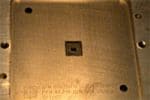
Great Lakes Engineering produces a wide variety of small, hand-held stencils. These can very from simple single-foil BGA rework stencils to more complex multi-foil framed stencils.

Mini-stencils can be manufactured to your specific requirements to allow deposition of solder paste in tight places. These can be manufactured to thicknesses of .001” through .040”.Also, we can and include tabs and “half etch” bend lines on the stencil. This allows for a “handle” to be folded up. This makes it easier to place and remove the stencil.

Frames

The following frame sizes are what we currently carry in stock. We can accommodate any special needs in additional frame sizes not listed. All our frames are made out of aluminum, with either tubular aluminum frames, or aluminum caste frames.

Frame Size ID (in.) OD (in.) Frame Tolerance Foil Size (in.)
5 x 5 3.41 x 3.41 6.66 x 5.875 F/p .003 Dec. tol.+/-0.010 Other tol.+/-1/32 4 x 4
8 x 10 8 x 10 11.62 x 9.5 F/p .003 Dec. tol.+/-0.010 Other tol.+/-1/32 7 x 9
12 x 12 12.15 x 12.15 14.15 x 14.15 F/p .003 Dec. tol.+/-0.010 Other tol.+/-1/32 11 x 11
12 x 17 12.1 x 17.1 15.125 x 20.125 F/p .005 Dec. tol.+/-0.005 Other tol.+/-1/32 11 x 16
15 x 15 15.125 x 15.125 17.75 x 16 F/p .005 Dec. tol.+/-0.005 Other tol.+/-1/32 14 x 14
20 x 20 20.12 x 20.12 22.85 x 22.85 F/p .005 Dec. tol.+/-0.005 Other tol.+/-1/32 19 x 19
24 x 24 24.0 x 24.0 27.5 x 27.5 F/p .010 Dec. tol.+/-0.005 Other tol.+/-1/32 23.75 x 21.75
29 x 29 27.5 x 27.5 29 x 29 F/p .010 Dec. tol.+/-0.005 Other tol.+/-1/32 23.75 x 21.75
Fugi 4000 20.079 x 28.74 22.835 x 31.496 F/p .010 Dec. tol.+/-0.005 Other tol.+/-1/32 26.8 x 16.1


Low Profile (SPACE SAVER) Frames

Great Lakes Engineering now offers low profile stencil frames as an option on 29" x 29" orders. The new frame is over 60% thinner than standard frames, saving valuable shelf space.

This system consists of two parts.
  • 1. The "Spacer Frame" measures 29" x 29" O.D x 1" high. You'll need one "Spacer Frame" for each printer.
  • 2. The "Space Saver Frame" measures 29" x 29" O.D. x 1/2" high.
Space Saver Frames

This frame is stretched with polyester mesh to provide a flexible mounting platform for stainless steel stencils.Space Saver Frames The idea is simple. Each printer will use one "Spacer Frame" like a mounting platform. Simply interchange the thinner frames when the run changes. You will be able to store three frames in the space of one, saving real estate around the equipment.

We understand quality and compatibility are - rightfully - your main concerns. The "Space Saver Frame" is attached to the "Spacer Frame" using pins that are permanently captured in the "Spacer Frame". Bushings pressed into the "Space Saver Frame" receive the pins and prevent the assembly from shifting while being installed in the printer. Simply put, the product is designed to hold the same dimensions as the frame it replaces, ensuring a transparent transition.

Space Saver Frames

The system also eliminates problems associated with shipping bare stencil foils to SMT Printers, such as foil damage when attaching to frames and finger cuts. Because only the Space Saver Frame is sent to stencil washers there is no concern of damage to base frames from cleaning chemicals.

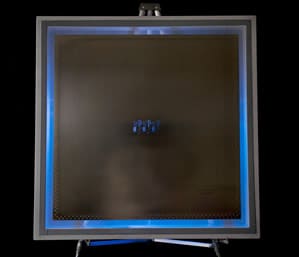
Our stencil supplier Great Lakes Engineering developed a space saver stencil that is a two piece stencil. As can be seen in Fig 1 & 2 it saves space by reusing the top 2/3 of the frame and needing to store only the bottom 1/3 of the stencil that contains the circuit pattern. Fig 3 shows the width of a standard stencil, which is 1.5”. Figure 4 shows the width of the space saver stencil, which is 1/2”. This will allow us to store 3 stencils in the same amount of space currently occupied by one of our stencils, freeing up valuable floor space.

Post Processes

Electroless Nickel Plate is also a post manufacturing process that deposits a thin layer of nickel on your stencil which provides a much harder, smoother surface on the inside aperture wall, and the stencil surface. This increases solder paste release properties.

Stencil Thickness Behavior and Paste Transfer Dynamics

Stencil thickness directly influences paste volume, aperture wall interaction, and release consistency. Thicker foils support larger components and higher paste deposits, while thinner foils improve definition for fine pitch features. Understanding how thickness interacts with aperture geometry, squeegee pressure, and paste rheology helps engineers select the correct foil for each assembly. This section explains how thickness selection affects bridging, voiding, gasketing, and transfer efficiency across mixed technology boards.

Aperture Geometry Strategies for Modern PCB Layouts

Aperture design extends far beyond simple shape selection. Geometry must account for pad behavior, solder mask clearance, and component specific requirements. Adjustments to aperture shape can influence wetting, voiding, and bridging outcomes.

Common geometry strategies include:

  • Modified home plate shapes for thermal pads
  • Window pane reductions for large deposits
  • Corner reliefs to improve release
  • Ratio based reductions for fine pitch pads
  • Trapezoidal shaping to support paste flow

These design choices help maintain consistent deposition across complex PCB layouts.

Foil Material Properties and Their Impact on Print Quality

Different stencil materials exhibit unique mechanical and surface characteristics that influence print performance. This section covers tensile strength, grain structure, surface roughness, and elasticity, explaining how each factor affects aperture integrity, squeegee wear, and long term dimensional stability. It also outlines when stainless steel, nickel, or hybrid foils are appropriate based on production volume and component density.

Printer Compatibility and Mounting Considerations

Stencil performance is influenced not only by fabrication method but also by how the stencil interfaces with the printer. This section explains alignment tolerances, frame rigidity, mesh tension, and mounting repeatability. It also covers how printer type, squeegee angle, and pressure settings interact with stencil design to maintain consistent paste deposition across multiple production runs.

Design for Stencil (DFS) Guidelines for PCB Engineers

This section provides guidance for PCB designers who want to optimize their layouts for stencil manufacturability. Topics include pad spacing, solder mask design, fiducial placement, and component orientation. It explains how early design decisions reduce the need for aperture modifications, step regions, or rework stencils later in the process.

Lifecycle Management and Stencil Longevity

Stencil performance changes over time due to wear, cleaning cycles, and repeated mechanical loading. This section outlines how to evaluate stencil condition, when to retire a stencil, and how cleaning chemistry affects foil surfaces. It also covers best practices for storage, handling, and inspection to maintain consistent print quality throughout the stencil’s service life.

Integration of Stencils into High Mix Production Environments

High mix assembly lines require rapid changeovers and consistent print performance across diverse PCB designs. This section explains how stencil selection, frame type, and foil thickness influence setup time, repeatability, and process stability. It also covers how modular frame systems and mini stencils support flexible manufacturing workflows.
FAQ

How Does Stencil Thickness Influence Solder Joint Formation?

Thickness determines paste volume, which directly affects joint height, wetting behavior, and thermal performance. Selecting the correct foil thickness ensures consistent deposition across components with varying pad sizes.

Why Is Aperture Wall Smoothness Important for Fine Pitch Components?

Smooth walls reduce friction during paste release, improving transfer efficiency and reducing the risk of insufficient deposits on micro scale pads.

What Factors Should PCB Designers Consider When Preparing a Layout for Stencil Production?

Pad spacing, solder mask clearance, fiducial placement, and component orientation all influence aperture design and stencil manufacturability.

How Do Cleaning Methods Affect Stencil Longevity?

Cleaning chemistry, frequency, and mechanical action can alter surface roughness and aperture integrity over time, impacting paste release and print consistency.